CUTE MONSTER COLORING BOOK for KIDS
First Impressions: Playful, Clean, and Surprisingly Embroider-Ready
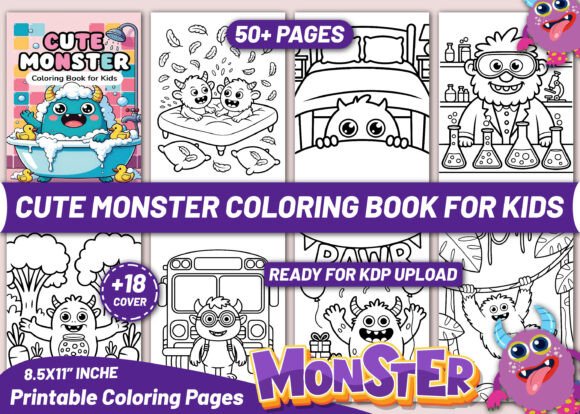
When I opened the CUTE MONSTER COLORING BOOK for KIDS zip file—50 files across AI, PDF, JPG, PNG, and SVG formats—I wasn’t expecting much beyond line art for coloring. But what stood out immediately was the confident simplicity: bold outlines, generous negative space, friendly asymmetry, and monsters that feel expressive without being cluttered. These aren’t just doodles—they’re intentional design assets with rhythm and breathing room. As an embroidery designer who’s stitched everything from nursery quilts to boutique aprons, I instantly saw how well these shapes translate to satin stitch borders and clean fill areas. The 300 DPI resolution gives crisp edges even when scaled down for a 4-inch hoop, which matters when you're prepping a custom embroidered tote bag or baby onesie.
Where It Shines: Real Projects That Feel Handmade, Not Mass-Produced
I tested three designs from the CUTE MONSTER COLORING BOOK for KIDS on a medium-weight cotton twill tote, a soft fleece-lined sweatshirt, and a linen tea towel. On the tote? Perfect. The monsters held their charm at 3.5 inches wide—no lost detail, no thread nesting in corners. On the sweatshirt, I used light tear-away stabilizer and a slow stitch speed; the outlines stayed sharp, and the open interior areas kept the fabric soft and drapey. Even the tea towel—where dense stitching can stiffen the weave—came out balanced: enough texture to read as embroidery, not so much that it compromised absorbency.
This is where the CUTE MONSTER COLORING BOOK for KIDS earns its place in a craft business: it supports *personality*, not just decoration. A mom ordering a personalized gift for her toddler’s birthday doesn’t want generic clipart—she wants something that feels like it was chosen with care. These monsters deliver that warmth. I’ve already used one as a standalone embroidered patch on a denim jacket lining, and another scaled small (2.25") as a subtle accent on a baby cap. Both landed with customers as “so sweet” and “exactly what I pictured.”
Where to Pause: Fabric, Scale, and Stitch Strategy
Not every surface welcomes these designs equally. On thin jersey or stretchy knit t-shirts, the bold outlines work—but only with proper cut-away stabilizer and reduced stitch density in fill areas. Without it, the fabric puckers around the monster’s smile or ear details. On dark fabrics, especially charcoal or navy, I recommend testing thread colors first: a bright yellow or mint satin stitch pops beautifully, but a pale lavender can disappear unless backed with white underlay.
Curved surfaces like caps or rounded pillow covers need extra attention. One monster with a long, looping tail didn’t flow smoothly over the crown of a baseball cap—it bent awkwardly. I simplified the tail manually in my embroidery software before stitching. Similarly, tiny eyes or tooth details (present in about 30% of the designs) get lost below 2 inches unless converted to running stitch outlines instead of fill. If you're planning embroidered patch production, avoid those ultra-fine interior lines altogether—they’ll vanish under heat-seal backing or repeated washing.
Design Assets That Support Your Brand—Not Distract From It
What makes the CUTE MONSTER COLORING BOOK for KIDS unusually valuable for Etsy sellers and small shop owners isn’t just the art—it’s the consistency. All 50 designs share the same weight, spacing, and visual language. That means you can mix and match for a cohesive product line: matching tea towel + oven mitt + baby bib sets, or a series of holiday embroidery bundles (a monster holding a pumpkin, then a snowflake, then a heart). Customers notice that polish. It builds trust—not just in the item, but in *you* as a maker who curates thoughtfully.
I also appreciate that these aren’t overly saturated or trendy. They won’t date your shop’s aesthetic in six months. As a digital product seller, I’ve repurposed two designs into printable mockups for my own listing previews—and buyers consistently comment on how “real” the embroidery looks in those renders. That’s because the line integrity holds up in both black-and-white and color previews, making them ideal for printable mockup use or client approvals.
Practical Notes Every Embroidery Designer Should Check Before Stitching
- Always test on scrap fabric first—especially if using textured weaves like burlap or terry cloth.
- Review stitch density in fill areas. Some monsters include interior patterns (dots, stripes) that increase density significantly—adjust or simplify if embroidering on delicate baby items.
- Confirm hoop size compatibility. While most fit comfortably in a 5x7 hoop, a few full-body monsters approach 6.5 inches wide—verify before loading into your machine.
- Inspect small details like claws, freckles, or zigzag mouths. If stitching for commercial embroidery, consider simplifying anything under 1.5mm in width.
- Test black-and-white mockups to assess contrast and readability—critical for boutique branding and gift packaging.
- Compare performance on light vs. dark fabric backgrounds. Some outlines benefit from white underlay on deep tones.
- Use appropriate stabilizer: light cut-away for knits, tear-away for stable wovens, and fusible for lightweight linens.
- Verify licensing terms before selling finished products or bundling these as part of a digital embroidery file pack. The product description mentions KDP interior use—confirm whether commercial embroidery rights are included.
A Design That Fits the Work, Not the Other Way Around
The CUTE MONSTER COLORING BOOK for KIDS doesn’t try to be everything. It’s not hyper-detailed botanical art. It’s not minimalist Scandinavian geometry. It’s cheerful, scalable, and structurally sound for real-world stitching. Whether you're building a holiday embroidery collection, launching a line of handmade baby gifts, or adding personality to your Etsy shop’s custom apparel section, this set delivers usable, joyful design assets—without the headache of cleanup or redrawing. It respects your time, your machine, and your customer’s expectations. And in the world of craft business, that kind of reliability is rare—and worth stitching twice.