FOOD DRINK SWEETS Coloring Pages
A Designer’s First Look: Playful, Not Precious
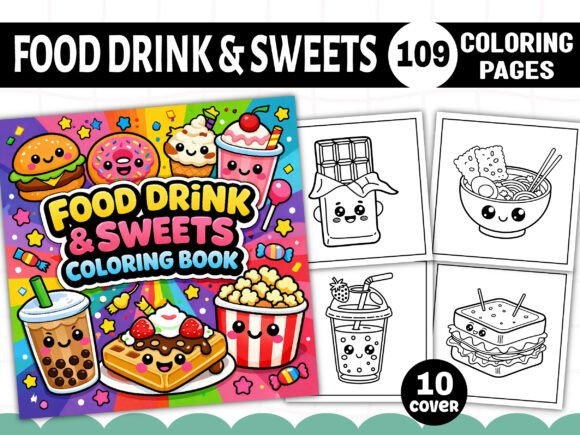
When I opened the FOOD DRINK SWEETS Coloring Pages zip file, I wasn’t scanning for “cute”—I was checking for embroiderability. These aren’t clipart-style icons; they’re hand-drawn coloring book illustrations with gentle line weight, open shapes, and intentional negative space. Think lollipops with soft swirls, coffee cups with steam curls, donuts with sprinkles spaced just wide enough to avoid thread crowding—not tight clusters that’ll blur into a muddy satin stitch blob. The mood is cheerful but grounded: nostalgic without being kitschy, detailed without being fussy. That matters because real embroidery doesn’t flatter busy, overworked lines—it rewards clarity, rhythm, and breathing room.
Where This Design Shines in Real Projects
I tested FOOD DRINK SWEETS Coloring Pages on a custom embroidered canvas tote bag for a local bakery’s holiday pop-up. The design sat beautifully on the front panel—large enough to read at arm’s length, small enough to leave room for branding. It worked equally well scaled down for a baby onesie (a single cupcake motif) and enlarged for a tea towel hem. Why? Because the outlines are consistent, the curves flow naturally, and there’s no fine interior crosshatching that would vanish under fill stitch or trap lint. As a machine embroidery design, it translates cleanly into satin-stitched borders and smooth fill areas—no jagged vectors or unintended gaps. For Etsy sellers, this means faster digitizing prep; for craft business owners, fewer re-stitching passes and happier customers who recognize the charm in the finished product.
Small-Business Friendly Use Cases
- Tote bag design: Perfect center-front placement—holds attention without overwhelming fabric texture.
- Sweatshirt embroidery: Works on midweight fleece when stitched with light tear-away stabilizer and medium-density fill.
- Embroidered patch: Clean edges hold up well in heat-applied or sew-on versions—ideal for aprons or denim jackets.
- Baby embroidery: Soft shapes feel gentle and age-appropriate; avoids sharp angles or tiny details that snag.
- Holiday embroidery: Fits seamlessly into gift sets—think cookie-themed kitchen towels or hot cocoa mugs on throw pillows.
Where to Proceed Thoughtfully
This isn’t a one-size-fits-all embroidery file—and that’s honest, not limiting. FOOD DRINK SWEETS Coloring Pages needs mindful adaptation for certain contexts:
- Hoop size & density: Some motifs span 4–5 inches. On a small hoop (under 4”), you’ll need to split or simplify—especially for curved surfaces like caps or baby hats.
- Fabric texture: On heavy linen or terry cloth, fine outlines may soften. Test first on scrap with your intended stabilizer combo.
- Dark fabric: The original line art assumes light backgrounds. For black or navy, use contrasting thread (e.g., cream or pale yellow) and consider slightly bolder digitized outlines.
- Stretchy fabric: Avoid direct application on knits without cutaway stabilizer and reduced stitch density—those swirling candy stripes can distort if tension isn’t dialed in.
- Frequent washing: If used on kitchen towels or baby items, confirm your thread colorfastness and avoid overly dense fill areas that stiffen after laundering.
What This Design Adds to Your Handmade Product
It brings warmth—not just visual, but emotional. Customers respond to recognizable, joyful themes, and FOOD DRINK SWEETS Coloring Pages lands that balance: it feels handmade, not mass-produced. When stitched cleanly, it elevates a plain sweatshirt into a personalized gift. On an apron, it signals approachability and craft. In a boutique setting, it supports brand consistency without shouting—ideal for cafes, bakeries, or gift shops building cohesive merch lines. Most importantly, it builds trust: buyers see intention in the spacing, confidence in the flow, and care in the execution. That perception of professionalism directly impacts perceived value—and what people are willing to pay for your finished product.
Practical Notes Every Embroidery Designer Should Check
- Always test FOOD DRINK SWEETS Coloring Pages on scrap fabric first—same type, same stabilizer, same thread.
- Review stitch density: high-fill areas (like chocolate bars or layered pastries) may need reduced density for breathability and drape.
- Confirm hoop size compatibility before prepping client work—don’t assume all motifs fit standard 4x4 hoops.
- Inspect small details: tiny sprinkles or steam wisps may need slight enlargement or simplification for reliable stitching.
- Test in black-and-white mockups to assess contrast and silhouette strength—what reads clearly in grayscale will read well in thread.
- Compare performance on light vs. dark fabric backgrounds using your actual thread palette.
- Use proper stabilizer—light tear-away for stable cottons, cutaway for knits or textured weaves.
- Verify licensing terms before selling finished items or bundling as part of digital embroidery files—this is a Graphics asset, not automatically commercial-use cleared.
Final Thought: A Reliable Spark, Not a Shortcut
FOOD DRINK SWEETS Coloring Pages won’t replace your design judgment—but it does reward it. It’s not a plug-and-stitch solution. It’s a thoughtful starting point: flexible enough for custom apparel, precise enough for boutique branding, warm enough for personalized gifts, and clean enough for commercial embroidery. Whether you’re an Etsy seller launching seasonal listings, a small shop owner refreshing kitchen merch, or a hobbyist stitching for joy—this set earns its place in your design assets. Just remember: great embroidery starts with respect for the line, the fabric, and the person who’ll hold the finished product in their hands. Let FOOD DRINK SWEETS Coloring Pages support that intention—not substitute for it.