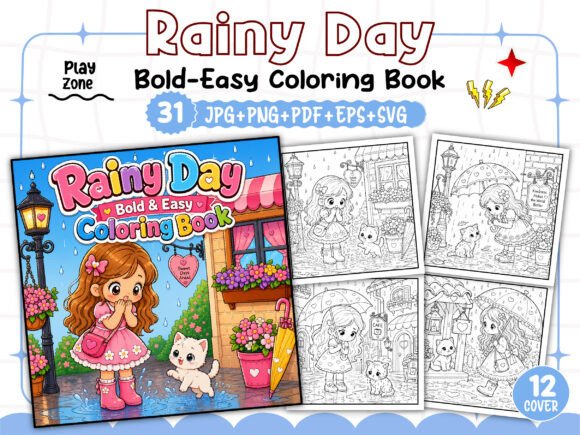
Rainy Day Story Coloring Book
A Designer’s First Glance: Soft, Storybook Charm — But Is It Embroiderable?
Opening Rainy Day Story Coloring Book, I immediately felt its gentle, nostalgic pull—clouds with smiling faces, raindrops trailing like tiny pearls, umbrellas tilted just so, and a child holding a teacup under shelter. It’s not bold or graphic; it’s tender, quiet, and full of breathing room. That’s promising for embroidery—but only if you know *how* to translate that softness into stitch. This isn’t a high-contrast logo or a dense mandala. It’s a coloring page repurposed as design asset—and that changes everything.
Real Project Test: Embroidering a Linen Kitchen Towel for a Local Boutique
Last week, I used Rainy Day Story Coloring Book as the centerpiece for a limited-run embroidered tea towel series—intended for a small-town gift shop specializing in handmade home goods. I chose medium-weight natural linen, a tear-away + cut-away stabilizer combo, and matte cotton thread in muted slate, moss, and cream. The result? A piece that felt intentional, warm, and quietly special—not “busy,” but *considered*. Customers paused at the display. One said, “It makes me want to brew tea and watch the rain.” That’s the power of mood-aligned execution.
Where This Design Truly Shines
- Personalized baby items: Stitched on organic cotton onesies or muslin swaddle blankets, the gentle lines read clearly even at 3.5"–4" width—no jagged edges or lost details.
- Tote bags & aprons: Works beautifully when scaled to 5"–6" wide. The open composition leaves space for text or monograms without visual crowding.
- Pillow covers & nursery decor: Its balanced negative space prevents “stitch fatigue” on larger surfaces—no dense fill-stitch walls to flatten texture.
- Holiday or seasonal gifts: Paired with a simple stitched tag (“Made for Rainy Days”), it reads as thoughtful—not trendy—and fits spring showers, back-to-school calm, or cozy autumn afternoons.
- Digital product prep: As a Coloring Pages asset, the clean line work converts cleanly to vector outlines for printable mockups, SVG previews, or embroidery digitizing reference.
Use With Care: Situations That Demand Extra Judgment
This isn’t a plug-and-stitch file for every surface. Here’s where I slowed down—and why you should too:
- Small hoop sizes (under 4"): The umbrella handle and raindrop trails shrink into ambiguity. Tiny curves blur; fine stems vanish. Always test at your target size first.
- Stretchy or thin fabrics (like jersey or voile): Without proper stabilizer and tension control, those delicate lines can pucker or distort. Not impossible—but not beginner-friendly.
- Dark or textured backgrounds: The original line art has no built-in contrast. On charcoal twill or bouclé wool, subtle elements like cloud outlines or raindrop dots may disappear unless you adjust thread weight or add underlay.
- Caps and curved surfaces: The asymmetrical layout doesn’t wrap well. Avoid center-crown placement—opt for side-panels or strap accents instead.
- Frequent-wash items (baby bibs, kids’ towels): Low-density satin and running stitches hold up fine—but avoid heavy fill-stitch reinterpretations. Stick close to the original line weight.
What It Adds to Your Finished Product—Beyond the Stitch
Rainy Day Story Coloring Book elevates perception—not just appearance. When stitched thoughtfully, it signals care, narrative intention, and handmade authenticity. Buyers don’t just see “a rain design”—they sense pause, comfort, and story. That translates directly to perceived value, repeat customers, and stronger Etsy or boutique branding. It also pairs seamlessly with complementary hand-lettered phrases (“Stay Cozy,” “Puddle Jumpers Welcome”) without competing visually—a rare win for collaborative design work.
Practical Notes Every Embroidery Designer Should Check
- Test on scrap fabric first—same fiber, same stabilizer, same thread. Line clarity shifts dramatically between cotton duck and rayon-blend twill.
- Review stitch density in your embroidery software. If converting from PNG, avoid over-digitizing fine details—let the simplicity breathe.
- Confirm licensing before selling finished items. Since this is listed as a Graphics download for KDP interiors, verify commercial use rights for physical embroidered products.
- Check how it renders in black-and-white mockups. If it loses legibility without color cues, simplify further before stitching.
- Compare light vs. dark background mockups. Adjust thread contrast accordingly—e.g., charcoal thread on oat linen reads warmer than black on navy.
- Inspect corners and intersections. Coloring-page lines often meet loosely—clean up overlaps manually if digitizing for precision.
- Ask: Does this support my brand voice? If your shop leans modern-minimal or rustic-bold, this leans storybook-soft. That’s fine—just be intentional.
Final Thought: A Quiet Design With Real Weight
Rainy Day Story Coloring Book won’t shout from a craft fair table—but it will draw people in, slow them down, and make them remember your shop. It’s not flashy. It’s not technical showmanship. It’s emotionally literate design, translated into stitch-ready potential. Used with attention to fabric, scale, and context, it becomes more than decoration—it becomes a quiet invitation to pause, connect, and create something that feels meaningfully made. That’s the kind of detail that turns a craft business into a trusted voice—and a coloring page into a keepsake.