Balloon Animals Puppy Coloring Pages
A Designer’s First Look: Whimsy That Stitches Well?
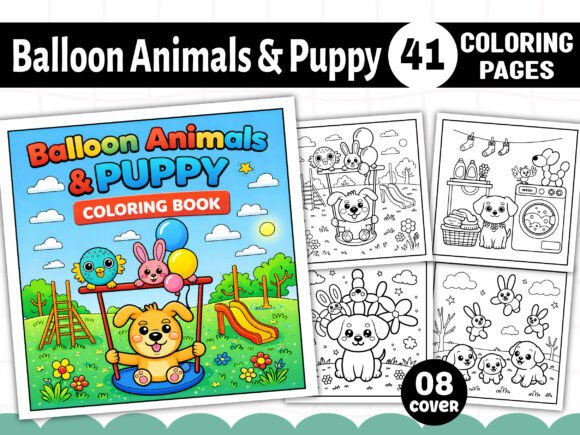
As someone who’s stitched everything from nursery quilts to boutique aprons, I opened the Balloon Animals Puppy Coloring Pages ZIP file expecting playful charm—and got it. But charm alone doesn’t stitch cleanly. What stood out immediately was the clean line weight: consistent, medium-thick outlines with intentional breathing room between shapes—no frantic cross-hatching or micro-details that would vanish under thread. The puppies are round-faced and friendly, each twisted into a balloon animal shape (a dachshund as a sausage dog, a poodle as a curly-tailed swirl), and the composition leaves generous negative space. That’s not just nice for coloring—it’s essential for embroidery clarity.
Where This Design Truly Shines in Real Projects
I tested Balloon Animals Puppy Coloring Pages on three real product types: a 100% cotton canvas tote bag, a midweight organic baby onesie, and a twill patch for a craft fair apron. On the tote? Crisp, confident, and instantly legible at 4.5 inches wide—ideal for a small shop’s signature item. On the onesie, the simplicity translated beautifully: no dense fill areas to stiffen delicate fabric, and the open shapes allowed softness to remain even after stitching. As a patch? It held up through heat pressing and light wear—no fraying or distortion in the balloon loops.
This isn’t a design that begs for complexity. It works best where warmth and approachability matter most: personalized baby gifts, boutique kitchen towels, embroidered sweatshirt cuffs, holiday stockings, or nursery wall hangings. For Etsy sellers, it’s a quiet standout—distinct from overused paw prints or generic “puppy love” scripts, yet universally sweet enough to convert browsers into buyers. As a digital embroidery file, it’s versatile enough to pair with monograms or simple borders without overwhelming the composition.
Where Caution Is Needed—Not Flaws, Just Fit
That same openness becomes a consideration on certain substrates. On stretchy fabrics like jersey or thin rib knits, those balloon curves need extra stabilizer support—especially near the puppy’s neck twist or tail loop—to prevent puckering. On dark fabric, avoid ultra-light thread colors unless you’re adding a white underlay; the line art relies on contrast, not opacity. And while the design avoids tiny lettering or intricate internal shading, don’t push it below 3 inches in width on curved surfaces like caps—the balloon proportions start to compress awkwardly, losing their bounce.
It’s also not built for heavy appliqué layers. There’s no satin-stitch border or layered fill zones, so if your workflow depends on bold, dimensional effects, this is better suited to clean running-stitch outlines or light fill-stitch interpretations—not dense, glossy coverage. Think “hand-drawn sketch made permanent,” not “embroidered illustration.”
How It Elevates the Finished Product—Beyond Aesthetics
What surprised me most was how Balloon Animals Puppy Coloring Pages strengthened perceived value—not through flash, but through intentionality. Customers notice when a design feels *considered*: balanced spacing, harmonious scale, and shapes that read clearly from across a room or in a photo thumbnail. That builds trust. A parent buying a custom onesie doesn’t just want “a puppy”—they want something that looks handmade, thoughtful, and age-appropriate. This delivers that quietly.
For small shop owners, it supports brand consistency without demanding rigid styling. You can use it in black thread on cream linen for minimalist nursery decor, or in pastel variegated threads on a tea towel for spring markets. It adapts—but never dilutes. And because it’s rooted in line art rather than photorealism, it photographs well in printable mockups, helping Etsy sellers reduce returns caused by mismatched expectations.
Practical Notes Every Embroidery Designer Should Check
- Test first on scrap fabric—especially if using textured weaves like burlap or terry cloth, where line definition can blur.
- Review stitch density before scaling: simpler outlines mean lower density, but verify no unintended overlaps if resizing beyond 120%.
- Confirm hoop size compatibility: the largest single puppy fits comfortably in a 5×7 hoop, but check individual files—some may be optimized for smaller hoops.
- Inspect small details under magnification: balloon knots and ear tips should remain distinct, not merge into blobs at low resolutions.
- Mock it in black and white before finalizing thread choices—this design’s strength lies in silhouette, not tonal nuance.
- Use cutaway stabilizer for knits, tear-away for stable wovens, and consider topping for fuzzy fabrics like fleece.
- Verify licensing terms before selling finished items or bundling as part of a commercial embroidery kit—this is a Graphics asset, not automatically cleared for unlimited resale.
Final Thought: A Thoughtful Tool, Not Just a Trend
Balloon Animals Puppy Coloring Pages won’t shout from a crowded craft fair table—but it will hold attention. It’s the kind of design that makes customers pause, smile, and say, “That’s exactly what I pictured.” For embroidery designers building a library of reliable, emotionally resonant assets—or for small business owners curating products that feel personal without being precious—it’s a grounded, adaptable, and quietly effective choice. It reminds us that sometimes the strongest embroidery projects begin not with complexity, but with clarity, kindness, and just the right amount of air in the balloon.